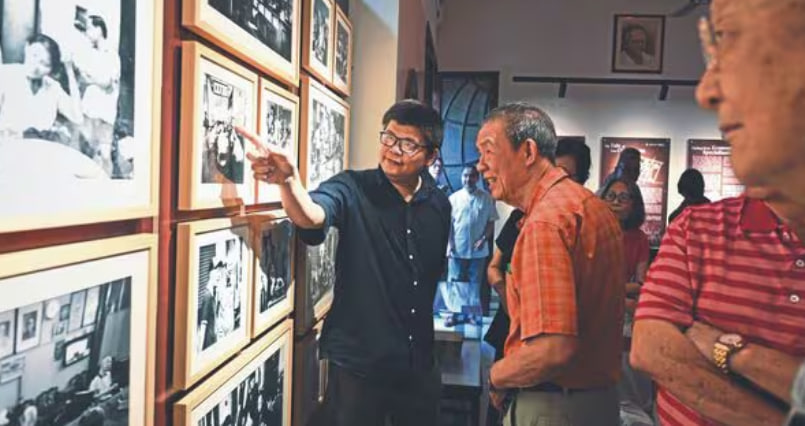
Inside the Huining Huiguan association in Kolkata is Cheenapara Heritage Gallery, which brings together photographs, artefacts and personal memorabilia to trace a community’s history。
At 17 Blackburn Lane, Kolkata stands Huining Huiguan, a native-association place and temple established in 1908 by Chinese migrants from Sihui. It now houses the Cheenapara Heritage Gallery, which opened last month and features photographs and artefacts of the city’s Chinese community living in Tiretta Bazaar, or Chinatown. Though the community has dwindled over decades, its legacy, rooted in the 18th and 19th centuries, endures in Kolkata’s heritage.
You can see photographs by Kolkata-based documentary photographer and filmmaker Bijoy Chowdhury of Chinese festivals and community life. The gallery highlights the cultural specialisations and occupational niches such as dentistry and carpentry, through which the community contributed to Kolkata’s development. There is a register featuring names of those who founded different clubs. The research focuses on the macro history of the community, its culture and livelihoods through personal memorabilia donated by family members and association members, according to Sohini Pyne, conservation architect and curator of the gallery.
The Cheenapara Heritage Gallery project has been led by Prof. Tansen Sen, director of Centre for Global Asia, NYU Shanghai, with the Indian National Trust for Art and Cultural Heritage, Calcutta Chapter, and Singapore-based CHA (Cities, Heritage, Architecture) urban design studio. In 1778, Chinese trader Atchew (or Yang Yazhao), who is considered by the Chinese community as their “first” ancestor, received land from Governor-General Warren Hastings for a sugar plantation near the Hooghly river. Though short-lived, Atchew’s venture attracted Chinese labourers to Kolkata, where a community gradually emerged.
The first Chinese settlement came up at Achipur in present-day Budge Budge, and after the First Opium War (1839-1842), migration to Kolkata increased particularly from Guangdong.
Lives and Livelihoods
As per the gallery’s research curations, Cantonese migrants, renowned for carpentry, ran flourishing firms such as Guangdexing Brothers and Guangdong Carpentry, a few of which still operate in Tiretta Bazaar. Hubeinese migrants, expert “teeth setters”, established around 80 dental clinics across the city after World War II.Shandong migrants traded in silk, garments and groceries, and many managed beauty parlours and laundries, including Shanghai Co., established in 1936 and still running. The Hakka community built a thriving shoemaking trade before founding tanneries in Tangra; by the early 20th century, several Hakka-owned shoe shops stood on Bentinck Street. Wartime demand drove the tannery industry to its peak in the 1940s, but mass-produced footwear and environmental restrictions later caused its decline, with many tanneries converting into Chinese restaurants.
Huiguans (native-place associations) served multiple functions, including lodging, worship venues, community meeting spaces, cultural preservation centres, and conflict resolution forums. They helped maintain sub-regional identities among Kolkata’s diverse Chinese population. Currently, there are six native-place associations in the city.
Preserving the Past
Even the community’s language carries traces of history slowly disappearing. Prof. Tansen explains how a few Hakka and Cantonese dialects still survive in Kolkata, some of which are difficult to find in China. “These languages need to be preserved, documented and studied. At the same time, knowledge of Chinese more broadly within the community is also in decline as reflected in the disappearance of Chinese-language newspapers that were once published,” he says.
During his research, ongoing since 2007, he discovered that the available material was inadequate. For instance, the establishment dates of several temples recorded in published sources appear to be uncertain, and in some cases likely inaccurate. Chinese accounts from the 1950s contain errors, particularly about Atchew, including his original Chinese name.
“We are therefore examining previously unused inscriptions as a way to recover new evidence and refine the historical record.” The research team has found a rich source of information in the colonial archives with the Intelligence Bureau having nearly 200 files, from 1910 onwards, on the Chinese community. For Prof. Tansen, the Cheenapara Heritage Gallery offers a way forward for other clubs as well. The team is planning another such gallery in Tangra.
Chen Yaohua, president of the Huining Huiguan and manager of the gallery, played an instrumental part in encouraging the community to donate documents and artefacts like shoemaking, dentistry and carpentry tools, religious lamps and sticks. The fact that only a handful of the older generation remain while the younger generation has moved to other countries explains why so much of the community’s history has remained tucked away in archives, academic journals, and the memories of an ageing generation.
According to Rinkoo Bhowmik, founder of the CHA Project, the gallery is not a white-box museum. It is still part of the social club. That distinction matters as the gallery does not simply display history; it occupies a space that belongs to the community. “Few know there are six functioning Chinese temples in Tiretta Bazaar. We wanted to create awareness of adaptive reuse of such heritage buildings,” she says.
Sravasti Datta is a Bengaluru-based independent writer